EEF trial shows Talking Time© improves children’s language development
Children who took part in the early years oral language programme made an additional month of progress in language development, with promising signs for the children who need it most.
Talking Time©, the oral language programme delivered by LINGO, improves young children’s language skills, according to the results of a large independent trial published by the Education Endowment Foundation (EEF).
Children in nurseries running Talking Time© made, on average, one month of additional progress in language development compared with children in settings that did not receive the programme. The EEF has given this result a high security rating, its marker of confidence that a finding is robust. Practitioners were positive too, reporting that the training left them feeling confident to deliver the programme and support children’s language. Following these results, the EEF has also named Talking Time© one of its Promising Programmes.
Bigger gains for the children who need it most
The results were even more encouraging for children who often face the biggest barriers to language development. Children eligible for the Early Years Pupil Premium, and children with English as an additional language, made around two months of additional progress compared with their peers in other settings. Although these findings are based on smaller groups of they point in a promising direction, and practitioners agreed, reporting that the programme was particularly beneficial for children with language delays.
How the trial was run
The findings come from a randomised controlled trial, the most rigorous test available, involving around 1,700 children aged three and four across 123 early years settings in England. The trial was funded and commissioned by the EEF as part of the Department for Education’s Early Years Recovery Programme, supported by four Early Years Stronger Practice Hubs, and independently evaluated by the National Institute of Economic and Social Research (NIESR).
“Talking Time is based on extensive research demonstrating effective ways of talking with young children to enhance their language skills. It’s extremely pleasing to see how well practitioners embedded these principles in the activities in their settings”
Professor Julie Dockrell, Professor of Psychology and Special Needs at Institute of Education, UCL
The importance of oracy
Oral language is the foundation of everything children do at school. It shapes how they access learning, develop literacy, build friendships and make sense of the world around them. Children who start school with weaker language skills are more likely to face challenges throughout their education, with children from disadvantaged backgrounds particularly at risk.
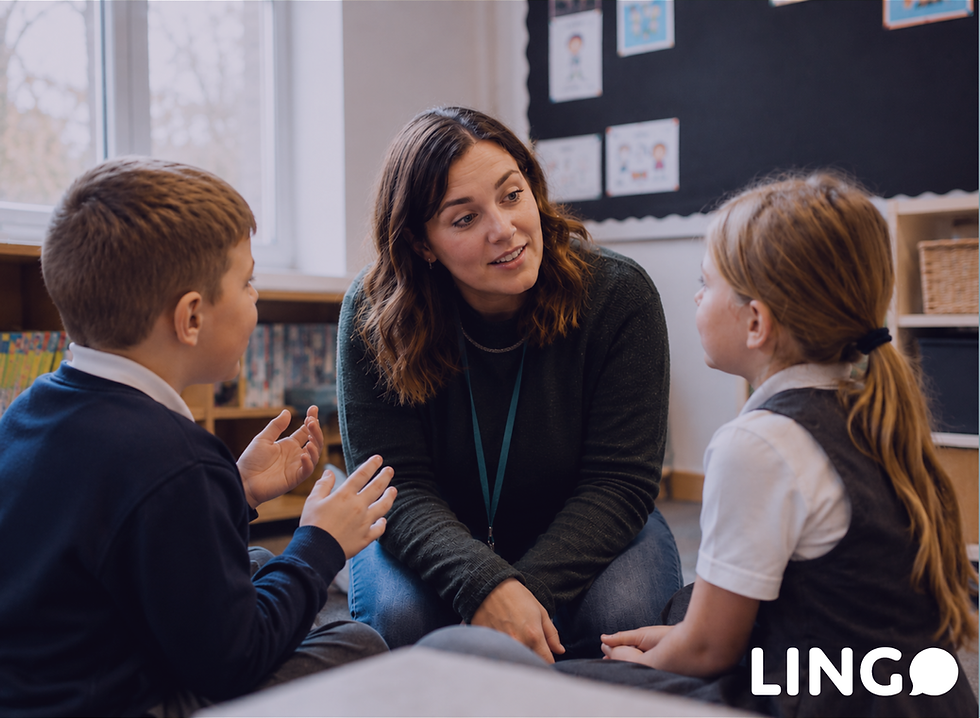
Talking Time© was designed to address that challenge. Developed by the IOE, University College London, the University of Oxford and LINGO, it is a universal programme, delivered to all children in a setting — not just those with identified difficulties. Children take part in two 15-minute small-group sessions a week over 20 weeks, built around shared storytelling, playful language games and conversations about familiar everyday experiences. Alongside the children’s sessions, practitioners receive structured professional development, with training and expert mentoring throughout, so that the skills they build last well beyond the programme itself.
Language that lasts
The trial found that the programme’s strongest effects were on children’s expressive vocabulary. This is the language children can actively use, not just the words they understand. Children attended well, with around 80% of children taking part in at least 80% of their sessions. Remarkably, the whole programme adds up to only around 10 hours of session time per child yet delivered a month of additional language progress on average, with early signs of around two months for the children who need it most.
“Talking Time is designed to fit the realities of busy early years settings. It gives practitioners a simple, structured way to make language-rich interaction part of part of daily practice rather than an add-on."
Dr Sandra Mathers, Associate Professor at the University of Oxford's Department of Education
The benefits did not stop when the trial ended. When evaluators returned to settings months later, most were still running Talking Time© independently. Practitioners described lasting changes to their everyday practice, from more open-ended questioning and more child-led conversations to language-supporting strategies woven through the whole day, not just the sessions themselves.
“We’re thrilled with these results. What makes Talking Time© special is that it doesn’t just hand practitioners a script — it builds their expertise and confidence, so the benefits reach not only the children in the room today but every cohort that follows. Seeing settings continue the programme on their own, and hearing children using richer language in their play and conversations, is exactly what we hoped for.”
Wendy Lee, LINGO Professional Director
The partnership behind the programme
For us, part of what makes Talking Time© distinctive is the partnership behind it: a genuine coming together of research and practice. Professor Julie Dockrell at the UCL Institute of Education created the original programme, and Dr Sandra Mathers at the University of Oxford’s Department of Education led its expansion, developing the professional development programme. Working alongside them, Wendy Lee, LINGO’s professional director, contributed three decades of experience supporting children’s language in schools and early years settings. We believe it is this blend of world-class research and everyday practice, that helped produce a programme practitioners can deliver with confidence.
Bring Talking Time© to your setting
Talking Time© is available to nurseries, schools and PVI providers across England, with the next cohort beginning in October 2026. Places are limited, as every setting receives dedicated mentor support throughout. Click below to find out more or read the full EEF evaluation report.


Comments